
The History of Nicotine Pouches: From Swedish Snus to a Global Smoke-Free Category
Walk into any convenience store in the United States today, and you will find a shelf stacked with small, flat cans of nicotine pouches. The category barely existed a decade ago. In 2024, the global nicotine pouch market surpassed an estimated $3 billion, and some analysts project it could exceed
$40 billion before the mid-2030s. But the story behind that small pouch under your lip stretches back more than five centuries. Understanding where nicotine pouches came from is essential to understanding where the category is going and why it looks the way it does today.
Tobacco Crosses the Atlantic — and Sweden Rewrites the Playbook
The nicotine pouch's oldest ancestor is a pinch of ground tobacco inhaled through the nose. When Christopher Columbus made landfall on Hispaniola in October 1492, his crew observed indigenous people using tobacco in ways Europeans had never seen. Spanish and Portuguese sailors carried the plant back to Europe, and by the mid-1500s, physicians in Lisbon were experimenting with it as an herbal remedy.
The French ambassador Jean Nicot famously recommended powdered tobacco to Queen Catherine de Medici for her chronic headaches, a prescription that made nasal snuff fashionable across French aristocratic circles virtually overnight. Swedish botanist Carl Linnaeus later honored Nicot by naming the tobacco genus Nicotiana. Snuff reached Sweden by the early 1600s. The first recorded import of tobacco into the country appears in a 1601 Stockholm customs ledger, and the word "snus" itself shows up in a Finnish customs document dated 1637.

Throughout the 1700s, snus was a status symbol. Aristocratic men and women carried ornate snus boxes crafted from gold, silver, and porcelain. But the product itself was still a dry, finely ground powder meant for the nose. That changed when Swedish farmers got hold of it.
Rural Swedes took a practical approach. Using ordinary coffee grinders, they milled their own tobacco leaves and mixed the resulting powder with water and salt to create a moist preparation tucked under the upper lip rather than sniffed. This simple innovation created an entirely new product category: moist snus. By the time the French Revolution dismantled aristocratic snuff culture in 1789, Swedish working-class snus was already its own tradition, spreading from farms to factories and eventually becoming a defining feature of Swedish daily life.
Industrialization, Pasteurization, and the Making of Modern Snus
The 19th century transformed snus from a cottage product into an industrial one. The pivotal figure was Jakob Fredrik Ljunglöf, a Stockholm-based manufacturer who applied pasteurization, a controlled heat treatment, to snus production. Prior to Ljunglöf's method, snus was fermented. It is a slow process that took weeks and left the product vulnerable to bacterial contamination. Pasteurization compressed production timelines and gave manufacturers far greater control over the final product.
Ljunglöf's flagship brand, Ettan (Swedish for "The One"), became a household name and remains in production today, accounting for roughly
one-fifth of all snus sales in Sweden. The success of Ettan proved that snus could be manufactured at scale while maintaining quality.
Between 1846 and 1930, more than one million Swedes emigrated to the United States, carrying their snus habit with them. The tradition took root so firmly in Swedish-American communities that residents of other ethnic backgrounds nicknamed the main streets of these neighborhoods "snus boulevards." While snus never achieved mass-market penetration in the U.S. during this period, the cultural seed was planted. Generations later, it would matter that Americans had at least a passing familiarity with oral tobacco products when nicotine pouches arrived.
Cigarettes, Monopolies, and Snus's Near-Death Experience
The early 20th century nearly killed snus. In 1914, the Swedish parliament nationalized the entire tobacco industry, creating a state-owned monopoly called AB Svenska Tobaksmonopolet. The number of commercially available snus brands collapsed from roughly 400 regional varieties to just 17 standardized products.
Snus consumption peaked in 1919 at 7,000 metric tons. This is remarkable for a nation of only six million people, translating to about 1.2 kilograms per person. But the post-World War II era brought an American cultural wave, and with it, cigarettes. Smoking became the fashionable form of nicotine consumption, and snus sales entered a long decline. The turnaround began in the late 1960s, when published research linking cigarette smoking to lung cancer and cardiovascular disease prompted many Swedes to reconsider snus. By the 1970s, snus was staging a comeback.
The Portion Pouch Revolution and the EU Standoff
In 1973, Swedish Match scientists looked at an everyday object, the tea bag, and saw a better way to deliver snus. They created a thin, permeable pouch that allowed flavor and nicotine to pass through while keeping loose tobacco out of the user's mouth. The first commercial portion of snus, Tre Ankare, launched in 1977. Portion snus was cleaner, more convenient, and less conspicuous than loose snus. It quickly dominated the Swedish market and established the pouch format that nicotine pouches would later inherit.
In 1992, the European Union's Tobacco Products Directive banned the sale of oral tobacco products across all member states. The stated rationale was to prevent a new form of tobacco consumption from gaining a foothold in countries where it had no tradition. For Sweden, however, snus was not new. It was a centuries-old cultural practice used by roughly 20 percent of the adult population.

When Sweden negotiated its EU accession in 1995, the snus ban became a make-or-break issue. Sweden ultimately secured a permanent derogation allowing the continued sale of snus within its borders, on the condition that it would not actively export snus to other EU member states. This exemption remains unique in EU trade law and has been a recurring source of regulatory debate in Brussels ever since. The EU ban had an unintended consequence that would shape the nicotine pouch category decades later. Because the prohibition specifically targeted products containing tobacco for oral use, a future product that delivered nicotine without tobacco leaf would fall into a regulatory gray area.
Niconovum, Zonnic, and the Tobacco-Free Breakthrough
The intellectual godfather of the modern nicotine pouch is Karl Olov Fagerström, a Swedish psychometrician and nicotine researcher internationally recognized for developing the Fagerström Test for Nicotine Dependence, one of the most widely used clinical instruments in smoking cessation research. In 2000, Fagerström founded a company called Niconovum in Helsingborg, Sweden, with a deceptively simple idea: what if you could take the familiar snus pouch format and fill it with pharmaceutical-grade nicotine instead of tobacco? The resulting product would look and feel like a portion snus pouch but contain no tobacco leaf whatsoever.
After nearly eight years of research, development, and regulatory navigation, Niconovum registered its product, branded Zonnic, as a medicinal nicotine replacement therapy (NRT) in 2008. Zonnic launched as a 2-milligram pouch and was sold alongside nicotine gums and patches in Swedish pharmacies. It was the first commercially available tobacco-free nicotine pouch. In 2009, R.J. Reynolds acquired Niconovum, signaling that major tobacco companies recognized the commercial potential of a pouch that delivered nicotine without tobacco. The acquisition moved the concept from the pharmaceutical space to the consumer goods arena, a shift that would accelerate dramatically over the following years.
The Pandemic-Era Surge
Between 2019 and 2021, online sales of nicotine pouches accelerated sharply. Average monthly online sales reached 80,000 cans by 2019, with growth continuing into 2020 and 2021 as new brands entered the market and existing brands expanded their flavor and strength ranges. By the early 2020s, nicotine pouches had graduated from a niche alternative product to a standalone consumer category with its own shelf space, retail partnerships, and marketing ecosystem.
Regulation, Innovation, and the Modern Nicotine Pouch Landscape
Nicotine pouches exist at an unusual regulatory intersection: tobacco-derived but smokeless, entirely novel in form but governed by frameworks built for legacy products. The FDA's authority over this category was assembled incrementally through legislation and an expanding interpretation of what constitutes a tobacco product. The following breakdown traces that evolution.
- The Legislative Foundation: The Family Smoking Prevention and Tobacco Control Act of 2009 gave the FDA its first formal mandate over tobacco products, establishing the legal scaffolding that would eventually reach product categories not yet conceived when Congress passed the law, or the president signed it.
- The 2016 Deeming Rule: Seven years after the original legislation, the FDA's Deeming Rule extended regulatory authority to electronic nicotine delivery systems, a pivotal expansion that would ultimately bring nicotine pouches under the same compliance expectations as cigarettes and traditional smokeless tobacco products.
- PMTA Requirements: Because nicotine pouches contain nicotine derived from or related to the tobacco plant, manufacturers must submit a Premarket Tobacco Product Application, a rigorous scientific review process evaluating whether a given product is appropriate for the protection of public health.
- The January 2025 Authorization: In a landmark decision, the FDA authorized 20 nicotine pouch products through the PMTA pathway in January 2025, signaling formal regulatory acceptance of the category and marking the first wave of legally marketed pouches in the United States consumer market.
- The PMTA Pilot Program: Later in 2025, the FDA launched a dedicated pilot program to streamline PMTA review for modern oral nicotine pouches, an acknowledgment that the category had grown large and distinct enough to warrant its own accelerated regulatory infrastructure and framework.
- The MRTP Review Threshold: In January 2026, the FDA's Tobacco Products Scientific Advisory Committee convened to evaluate modified-risk tobacco product applications for nicotine pouches, the highest level of regulatory scrutiny the category has faced, with significant implications for how these products may be marketed to consumers.
The regulatory story of nicotine pouches is still being written. The FDA's progression reflects both the scientific complexity of these products and the scale of their commercial footprint. For manufacturers and brands operating in this space, understanding the regulatory infrastructure is no longer background knowledge.
A Wave of Product Innovation
Regulatory maturation has coincided with a burst of product innovation. Today's nicotine pouches bear only a passing resemblance to Zonnic's original 2-milligram pharmacy product. The modern market features more than 100 flavor combinations spanning mint, citrus, fruit, coffee, and even cocktail-inspired profiles. Pouches come in multiple formats, like mini (0.3–0.5 grams), slim (0.5–0.8 grams), and regular (0.8–1.2 grams or more), and nicotine strengths typically range from 2 milligrams to 12 milligrams per pouch.
One of the more meaningful distinctions in today's market is between dry-format and moist-format pouches. Dry pouches contain little to no added water, producing a slower, more gradual release. Moist pouches include water or humectants during manufacturing, resulting in faster activation and a fuller flavor profile from the first moment under the lip. Brands like
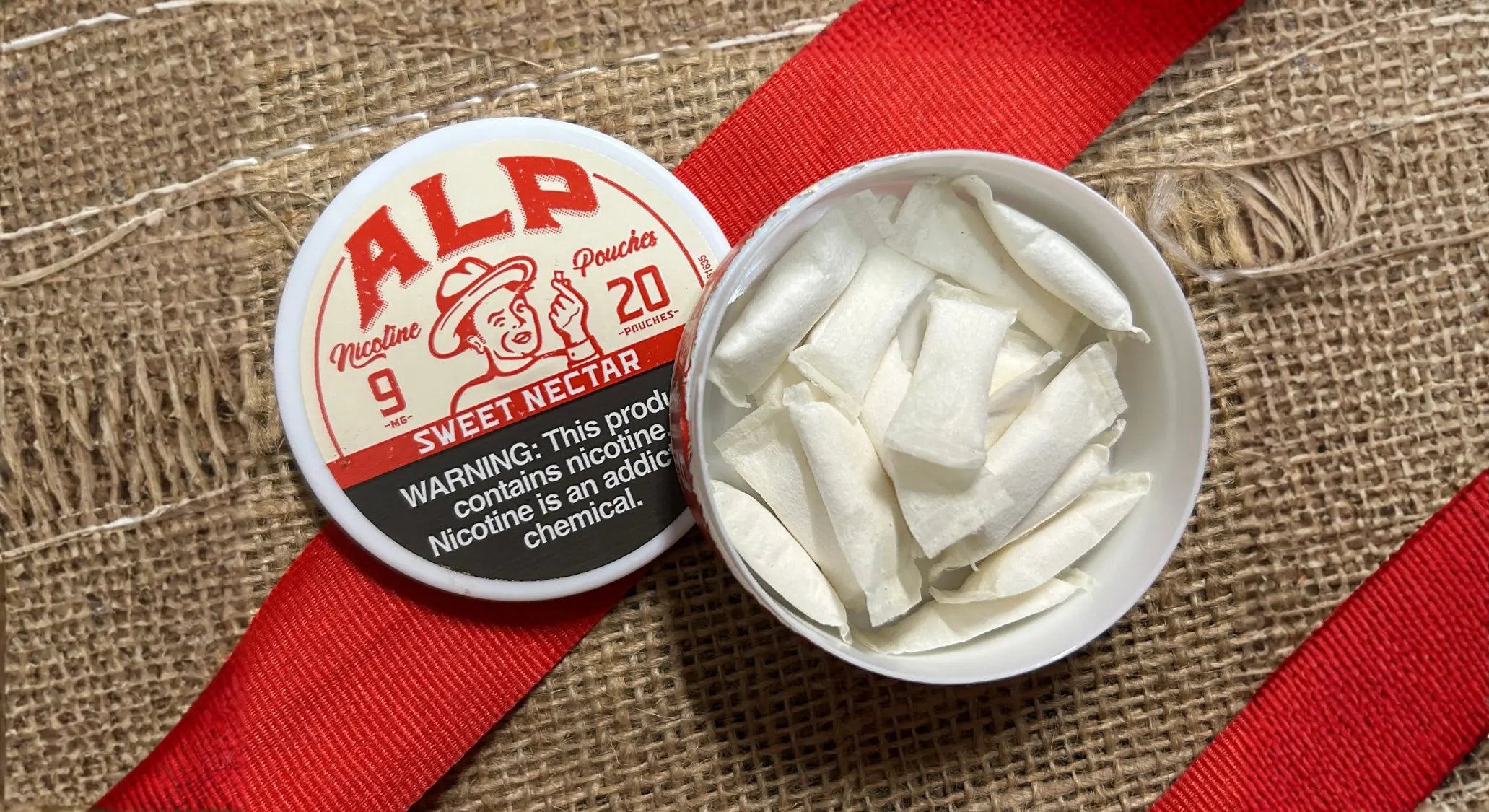
ALP have built their identity around moist, flavor-forward pouches, packing 20 pouches per tin in flavors ranging from Chilled Mint to Tropical Fruit, available in 3mg, 6mg, and 9mg strengths. ALP also partners with reforestation organizations, tying each purchase to tree planting in critical U.S. regions.
Beyond moisture levels, the innovation frontier is expanding into entirely new formats. Some brands have introduced chewable gum-base pouches, liquid-filled flavor capsules, and even plant-fiber-free "air pouches" that use compressed-material technology to release nicotine more rapidly. Synthetic nicotine, nicotine produced in a laboratory rather than extracted from tobacco plants, accounted for an estimated
86 percent of the market in 2024, a shift that further distances the category from its tobacco-leaf origins.

The journey from a Swedish farmer grinding tobacco in a coffee grinder to a multi-billion-dollar global product category spans more than 300 years. Along the way, every major inflection point, Ljunglöf's pasteurization, the tea-bag-inspired portion pouch, Sweden's EU exemption, Fagerström's tobacco-free concept, and the FDA's evolving regulatory framework, was built on what came before. What makes the nicotine pouch story unusual is that it is not a disruption story in the typical Silicon Valley sense. No single inventor or company broke the old model overnight. Instead, the category emerged through a long series of incremental innovations, each one solving a specific problem. That gradualism is also the category's greatest asset going forward. Unlike vaping, nicotine pouches have grown alongside their regulatory environment rather than ahead of it. For consumers, the practical result is a product category that is more transparent, more varied, and more accessible than at any point in its history. And for anyone who tucks a pouch under their lip today, it is worth knowing that they are participating in a tradition that stretches back to the fields and farmhouses of 18th-century Sweden.
Sources:
- History of Snuff — Swedish Match
- The Swedish Snus History — Swedish Snus and Match Museum
- A Short History of Swedish Snus — Daily Scandinavian
- When Were Nicotine Pouches Invented? — Vaping360
- The New Nicotine Pouch Category: A Tobacco Harm Reduction Tool? — Nicotine & Tobacco Research, Oxford Academic
- About Niconovum — Zonnic
- Family Smoking Prevention and Tobacco Control Act — FDA
- FDA Authorizes 6 Nicotine Pouch Products — FDA Newsroom
- FDA Schedules TPSAC Review of ZYN Applications — Tobacco Reporter
- Nicotine Pouches Market Size & Share — Grand View Research
- Nicotine Pouches Market Size, Forecast 2025–2034 — GM Insights
- Snus — Wikipedia
- Nicotine Pouch — Wikipedia