How Long Should You Keep a Nicotine Pouch In? Duration, Timing, and Best Practices
It's the question that every new nicotine pouch user types into a search bar within their first week, and one that even experienced users revisit once they switch strengths. How long should you actually keep a nicotine pouch in your mouth? The answer depends on the pouch's nicotine strength, its formulation, where you place it, and what you're trying to get out of each session. The global market is expected to reach roughly $6.96 billion in 2025, with projections pointing toward $42.5 billion by 2033. That growth has pulled in millions of first-time users who are navigating a product with no universal instruction manual.
What Actually Happens After You Place a Pouch
Understanding duration starts with understanding delivery. A nicotine pouch is a small, pre-portioned sachet containing purified nicotine, plant-based fiber, pH adjusters, and flavorings. Once it sits against your gum tissue, moisture from your mouth activates the pouch, and nicotine begins crossing the oral mucosa into your bloodstream.
This delivery mechanism is fundamentally different from smoking or vaping. Pouches reach peak plasma nicotine concentration (Tmax) at roughly 60 to 65 minutes, compared to just 7 minutes for a combustible cigarette. The absorption is slower and more gradual. What this means for you as a user is that the pouch doesn't "hit" all at once. There's a ramp-up phase, a plateau, and a gradual fade. The question of how long to keep it in is really a question of where in that curve you want to stop.

The 20-to-40-Minute Window: Why Most Users Land Here
If you survey the available guidance, you'll find a consistent window: 20 to 40 minutes per pouch, with 30 minutes serving as a reliable midpoint for most people. Here's why that range makes practical sense when mapped against the pharmacokinetic data:
- Minutes 1–5: Activation. The pouch begins absorbing moisture. You'll feel an initial tingling or mild warmth where the pouch contacts your gum. Nicotine release has started, but plasma levels are still climbing. Removing the pouch here would waste most of its potential.
- Minutes 5–15: Ramp-up. Nicotine delivery accelerates. The tingling sensation typically peaks during this window. Flavor is at its strongest. For higher-strength pouches (9 mg and above), this is often where users first feel the nicotine's effects — a subtle alertness or focused calm, depending on personal response.
- Minutes 15–30: Peak delivery. This is the productive core of a pouch session. Nicotine absorption is at or near its highest rate. Flavor remains present but begins softening. Most of the nicotine you'll absorb from the pouch transfers during this stretch.
- Minutes 30–45: Diminishing returns. The pouch is substantially spent. Flavor is fading noticeably. Nicotine continues to be released, but at a reduced rate. 60 minutes is an upper boundary, but most users find that the experience has run its course well before that mark.
- Beyond 45 minutes: The pouch has delivered the bulk of its nicotine. Continuing to hold it offers minimal additional absorption while increasing the chance of gum irritation from prolonged contact.
For most users, pulling the pouch for 20 to 40 minutes strikes the best balance of nicotine delivery, flavor, and gum comfort. The exact sweet spot within that range depends on your pouch's strength and your personal calibration, which we'll cover next.
How Nicotine Strength Changes Your Timing
Lower-Strength Pouches (2–4 mg)
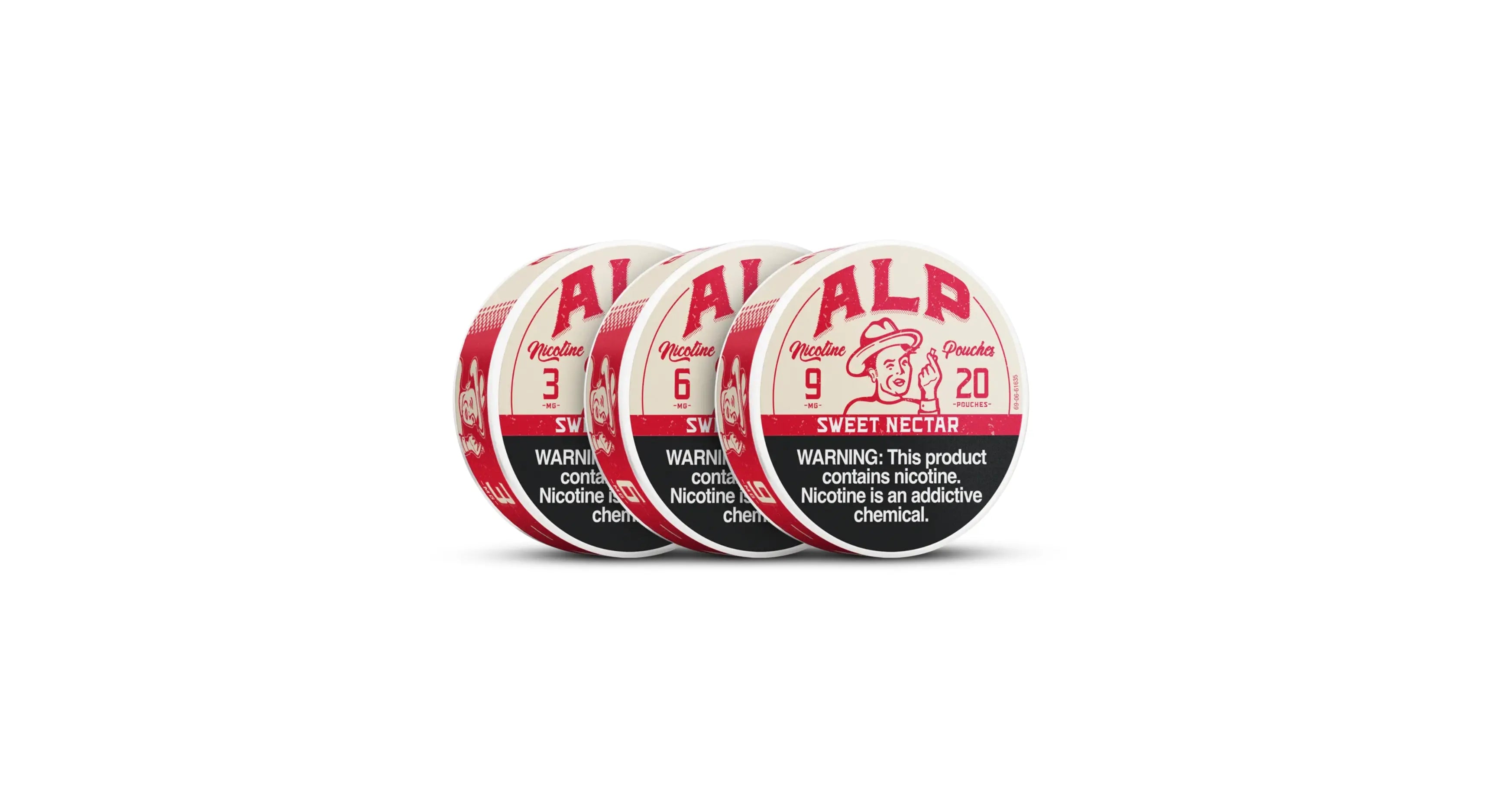
Pouches in this range release nicotine more gradually and at lower peak concentrations. You may want to keep these in for the full 30 to 40 minutes to get satisfying absorption. With less nicotine per pouch, shorter sessions deliver proportionally less nicotine. Brands like ALP, which offer pouches at 3 mg, 6 mg, and 9 mg strengths, make this kind of graduated experimentation straightforward. Starting with a 3 mg pouch and keeping it in for a full 30-minute session lets you establish a baseline before adjusting either strength or duration.
Mid-Strength Pouches (6–8 mg)
This is the range where most regular users settle. A 6 mg pouch kept in for 25 to 35 minutes typically delivers a satisfying session. You have more flexibility here. If you're short on time, even a 20-minute session will deliver meaningful nicotine. If you prefer a longer, mellower experience, aiming for 35 to 40 minutes works without excessive gum exposure.
Higher-Strength Pouches (9 mg and Above)
Higher concentrations mean faster ramp-up and more pronounced early effects. Cmax increases with nicotine strength, so the peak arrives sooner and hits harder. Many users of 9+ mg pouches find that 15 to 25 minutes is sufficient. The pouch delivers its payload more quickly, and extending the session doesn't proportionally increase satisfaction. If you're new to higher-strength pouches, start with shorter sessions (10 to 15 minutes) and extend gradually. This lets you measure your response without overcorrecting.
Placement Matters More Than You Think
Why the Upper Lip Is the Standard
The near-universal recommendation is to place the pouch between your upper lip and gum, slightly off-center to the left or right. There are three reasons this position outperforms alternatives. First, the upper lip area has fewer salivary glands. The major salivary glands (parotid, submandibular, sublingual) are concentrated in the lower jaw and cheek area. Placing a pouch in the lower lip or along the cheek triggers more saliva production, which dilutes the nicotine before it can be absorbed and increases the urge to spit or swallow. Both of which waste nicotine that should be crossing your gum tissue.
Second, the upper lip moves less. During conversation, eating, or drinking, the lower lip and cheeks are in near-constant motion. The upper lip provides a more stable pocket, allowing the pouch to maintain consistent contact with the mucosa. That consistent contact is what drives steady absorption. Third, discretion. An upper-lip pouch is virtually invisible to anyone looking at you. A lower-lip or cheek pouch tends to create a visible bulge.

Rotating Your Placement
Even with optimal upper-lip positioning, keeping the pouch in the same spot from session to session concentrates contact on a single patch of gum tissue. Alternating sides distributes the exposure and reduces localized irritation. This is especially important if you use multiple pouches per day.
What to Avoid
Don't place the pouch directly over your front teeth. Don't push it deep toward your molars, where it's more likely to shift and where proximity to salivary glands increases dripping. And once the pouch is in place, leave it alone. Repeatedly adjusting it with your tongue disrupts the contact seal and slows absorption.
Calibrating Your Personal Session Length
Here's a practical calibration method that takes about a week.
- Day 1–2: Establish a baseline. Use your usual strength pouch. Set a timer for 30 minutes. When the timer goes off, note three things: Is there still noticeable flavor? Do you still feel the pouch is "active" (mild tingling, warmth)? Are you satisfied with the session, or does it feel like it ended too soon or dragged on?
- Day 3–4: Adjust by five minutes. If 30 minutes felt like it ended too early, push to 35. If the last five minutes felt like dead time, drop to 25. Repeat the same three-question check.
- Day 5–7: Fine-tune and stress-test. Try your adjusted duration across different contexts: morning use, post-meal use, focused work, and commute. You may find that your ideal duration shifts slightly by situation. A morning pouch might warrant a full 35 minutes during a relaxed coffee routine, while a mid-afternoon pouch during a busy workday might be best at 20 to 25 minutes.
The goal is to develop an instinctive sense of when a given pouch session has peaked and is fading, so you pull the pouch at the right time without thinking about it.
Building a Daily Pouch Routine
Spacing Between Pouches
A minimum gap of 30 to 60 minutes between sessions is a practical baseline. This gives your gum tissue time to recover from the direct contact and lets your plasma nicotine levels settle between peaks. Back-to-back sessions compress the recovery window and increase the risk of irritation without meaningfully improving the experience.
Tracking Without Overthinking
You don't need a spreadsheet. But for the first week or two of intentional routine-building, a simple note — "6 mg, 25 min, 10:30 AM, good" — after each session can reveal patterns. Maybe you consistently pull your post-lunch pouch early because the flavor fades faster. Maybe your evening sessions run long because you're relaxed and not paying attention. Small observations lead to a routine that runs itself.
When to Remove a Pouch: The Signals That Matter
Rather than watching the clock exclusively, experienced users learn to read the pouch itself. There are three reliable signals that a session has run its course:
- Flavor extinction. When the flavor has faded to near nothing, the pouch is well past its peak delivery phase. Once you're no longer tasting anything, the pouch has given up most of what it has to offer.
- Tingling cessation. The initial tingling or warmth you feel when the pouch is fresh comes from nicotine actively crossing your gum tissue. When that sensation fades to neutral, absorption has slowed dramatically.
- Pouch texture change. A fresh pouch has a slight firmness and moisture. Over time, it softens and may feel thinner as its contents release. When the pouch feels notably flatter or spent than when you placed it, that's a physical confirmation that delivery is winding down.
If all three signals align, it's time. If you feel any sharp discomfort, burning beyond a mild tingle, or unusual irritation, remove the pouch immediately, regardless of how long it's been in. Discomfort is not a signal to push through. It's a signal to switch sides or take a longer break before your next session.
Common Timing Mistakes and How to Fix Them
Pulling Too Early
Removing a pouch after 5 to 10 minutes because the initial tingling feels intense wastes most of the nicotine. That tingling is the activation phase, not the peak. If the sensation is truly too strong, the fix is to keep a lower-strength pouch in for a full session. ALP's 3 mg option, for example, provides a milder entry point that lets you complete a full 20 to 30-minute session without the intensity of higher-strength products.
Leaving It In Too Long
Forgetting the pouch is there and leaving it in for 60, 90, or more minutes. Beyond the 45-minute mark, you're absorbing minimal additional nicotine while keeping a foreign material pressed against your gum tissue for an extended period.
Chewing or Fidgeting
Moving the pouch around with your tongue, biting down on it, or repositioning it repeatedly does two things: it accelerates flavor release and disrupts the consistent mucosal contact that drives steady absorption. Place it, and leave it.
Ignoring the Gum Rotation
Using the same gum spot for every session, every day, concentrates all the mechanical and chemical contact on one area. Even if individual sessions are perfectly timed, their effects on one patch of tissue add up. Alternate sides, and if you notice any persistent tenderness in a spot, give it a full day off.

The pharmacokinetics set the boundaries. The 20- to 40-minute window defines the productive range. But within those guardrails, the right duration is the one that fits your life. Even 10-minute sessions with 11 mg pouches produced measurable nicotine absorption. Shorter sessions aren't failures. They're simply lower-yield sessions that still deliver. What matters most is consistency and awareness. Know your pouch's strength. Know your body's signals. The rest is just practice.
Sources:
- A Randomised Study to Investigate the Nicotine Pharmacokinetics of Oral Nicotine Pouches and a Combustible Cigarette — European Journal of Drug Metabolism and Pharmacokinetics (PMC)
- Nicotine Pouch Pharmacokinetics Compared to Smoked Tobacco: A Systematic Review and Meta-Analysis (PMC)
- A Randomized Crossover Clinical Study to Assess the Effect of Oral Nicotine Pouches Used for Different Durations — Azzopardi et al., Journal of Clinical Pharmacology (Wiley)
- A Randomised Study to Assess the Nicotine Pharmacokinetics of an Oral Nicotine Pouch and Two NRT Products — Scientific Reports (Nature)
- HDAS London Nicotine Pouch User Guide — NHS Transformation Partners
- Nicotine Pouches Market Size & Share Industry Report — Grand View Research
- Nicotine Absorption 101: Why Placement and Time Matter — ALP